



Despite implementing various security solutions, data breaches continue to rise every year, highlighting the urgent need for stronger data privacy measures. One of the biggest challenges organizations face is a lack of visibility into their unstructured data – they often don’t know where sensitive information is stored, how it is being used, or whether it has been exposed. Without a clear understanding of their data landscape, organizations struggle to prevent data leaks and comply with evolving privacy regulations.
Fasoo Data Radar (FDR) automatically discovers, classifies, and monitors sensitive data across all storage locations. It provides real-time tracking and built-in security policies to ensure continuous protection and compliance. With FDR, organizations can gain full control over their unstructured data, reduce security risks, and simplify data management.
Discover sensitive unstructured data across endpoints, file servers, and other storage environments. Gain a clear view of what sensitive information you have and where it resides.
Identify and classify personal, confidential, and regulated information using predefined policies and customizable detection rules. Improve classification accuracy and reduce false positives with intelligent analysis.
Continuously monitor sensitive data and automatically apply appropriate security actions based on policy and risk. Protect information throughout its lifecycle without relying on manual interventions.
Complete Data Visibility Across All Storage
Identify and monitor sensitive data across Windows, Mac, file servers, and other storage locations to gain a clear view of where personal and confidential information resides.
Simplified Compliance Management
Identify and manage regulated information based on requirements such as GDPR, HIPAA, CCPA, PCI DSS, and other privacy regulations. Maintain visibility into sensitive data and apply consistent controls to support ongoing compliance efforts.
Real-time Monitoring and Automated Actions
Continuously scan for sensitive data and automatically take policy-based actions when risks are identified. Apply tagging, encryption, quarantine, deletion, or adaptive access controls based on the sensitivity and context of the data.
Fast and Accurate Data Detection
Detect and classify sensitive information with high-speed scanning, advanced filtering, predefined policies, and customizable detection rules. Reduce false positives and focus security efforts on data that requires protection.
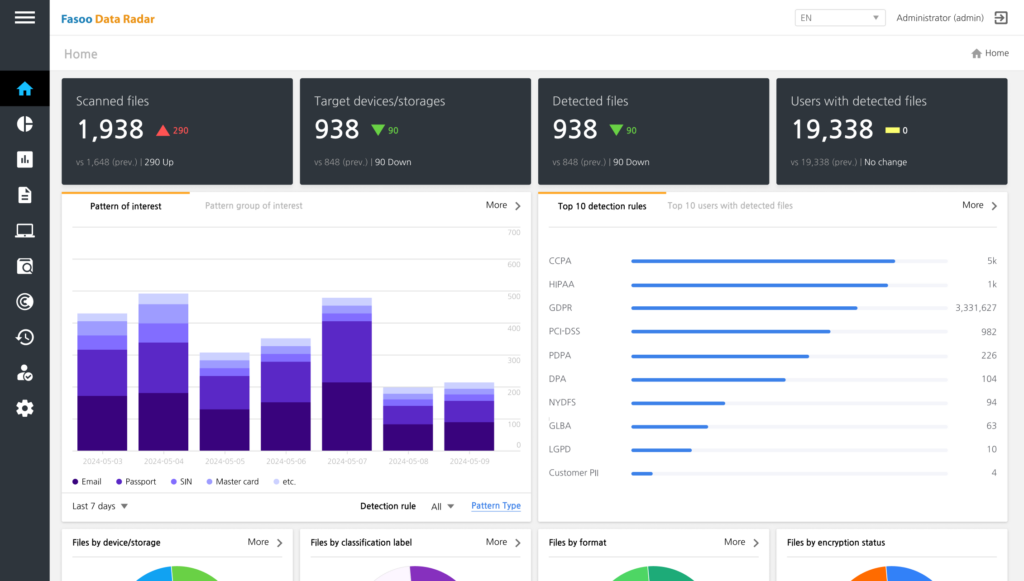
Fasoo Data Radar provides a centralized view of your data, showing its location, usage, and encryption status across databases, servers, and endpoint devices. With data visualization graphs, you can easily track data flow, file types, and access patterns, helping you identify files that require encryption, deletion, or archiving. The dashboard also enables real-time monitoring of detected files, letting you see who accessed sensitive data and when.

Videos
Watch how Fasoo Data Radar (FDR) discovers, classifies and protects sensitive data automatically while complying with data privacy regulations.
Brochures
Fasoo Data Radar can discover, classify, and protect sensitive data with smart “Pac & Tag” technology in a single automated workflow on file servers, desktops, laptops, and connected drives.

White Papers
Organizations need better visibility into the use and movement of their sensitive data to meet privacy regulations and safeguard content.
Fasoo Data Radar (FDR) is an advanced data discovery and classification solution that automatically identifies, categorizes, and tracks sensitive data.
Data discovery is the process of identifying and cataloging data across an organization’s various systems and databases. It involves using tools and techniques to scan, classify, and organize data, making it easier to understand and manage. Data discovery helps organizations uncover hidden patterns, relationships, and insights within their data, supporting informed decision-making and compliance with data governance policies. It is essential for data analysis to ensure that all relevant data is accounted for and appropriately handled.
Data classification is the process of organizing and categorizing data based on its level of sensitivity, importance, and confidentiality. This helps organizations manage their data more effectively by ensuring that sensitive information is protected and accessed only by authorized personnel. Data classification typically involves assigning labels or tags to data based on predetermined criteria, such as the type of data, the level of sensitivity, and the potential impact of unauthorized access or disclosure. Data classification can help organizations comply with regulations and legal requirements related to data privacy and security, as well as protect against data breaches and cyber-attacks. It can also help organizations optimize their data storage and management strategies by identifying which data is most valuable and should be prioritized for backup, retention, and archival purposes.
Data Security Posture Management (DSPM) is a strategic approach in cybersecurity that focuses on identifying, monitoring, and improving the security of an organization’s data. It provides comprehensive visibility into where sensitive data resides, how it is being used, and who has access to it, across various environments. By analyzing potential vulnerabilities in access controls, storage locations, and data flows, DSPM enables organizations to uncover unmanaged or hidden data, such as redundant or outdated files, which may pose security risks.
The goal of DSPM is to proactively mitigate risks, ensure compliance with regulatory requirements, and maintain strong security controls to protect sensitive information throughout its lifecycle. This approach empowers organizations to make data-driven decisions to strengthen their overall cybersecurity posture.
Loading form...