


Close the Print Security Gap

Protect sensitive customer data from print-related security risks.
Govern and monitor the printing of sensitive information with Fasoo Smart Print.

Is Your Organization Print-Secure?

Check the print security controls your organization already has in place. See how well your financial data is protected from print-related risks.

Your Print Security Score

0%

High Risk

Your organization has minimal protection against print-related security risks. Sensitive information can be printed without sufficient controls, increasing the risk of data leakage, insider threats, and compliance violations.

Recommended Next Step

Get a Demo

How It Works

Explore four steps from policy to proof.

1

SPECIFY

Choose what to protect

Select the documents, business applications, and printers that handle sensitive customer information or apply protection across your entire print environment.
2

SET A POLICY

Define print security policies

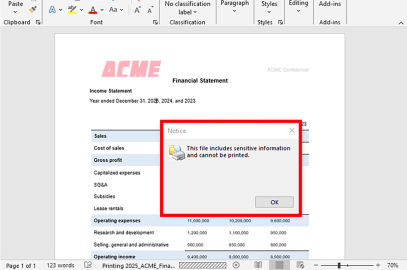
Choose how sensitive documents should be protected: block printing, require approval, mask sensitive information, apply dynamic watermarks, or combine multiple controls.
3

APPLY

Deploy and enforce

Deploy policies through an endpoint agent, server, or API integration without disrupting employee workflows.
4

TRACE

Monitor and trace every print job

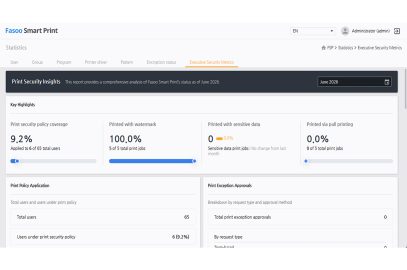
Every print job is logged with the user, document, printer, and timestamp, while sensitive information is masked. Each page is protected with a dynamic watermark for complete auditability.

Can You Trace a Leaked Printout Back to the Source?

Resources

FAQ

Will Fasoo Smart Print (FSP) affect the performance of core banking, claims, or CRM systems?

No. FSP applies print security policies at the output layer without requiring changes to underlying business applications, so day-to-day printing continues uninterrupted.

Yes. FSP works with any physical or virtual printer, eliminating problems from different printers or drivers, and across VPN and VDI environments, the setup most BFSI back offices already run.

FSP cannot physically stop paper from leaving the building. What FSP does is block or require approval for printing sensitive documents, mask PII on the output, stamp every page with a visible watermark (who printed it, and when), and log every job, so a leaked printout points back to the person, device, and time.

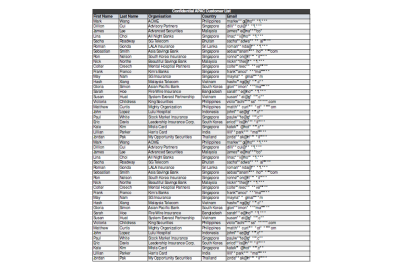
Masking removes or redacts sensitive fields (account numbers, national IDs) from the printed output, even from image-based documents, via OCR. Watermarking stamps each page with the printer’s identity: a visible deterrent and a way to trace a leaked printout back to its source.

FSP uses a client-server architecture: a single lightweight Fasoo client runs on each endpoint and enforces your policies, while a central server holds the policies, identities, and logs. Deploy it via endpoint, server, or API integration, and let Fasoo AI’s Live Update service keep every client patched automatically.

Yes. FSP supports the privacy and audit obligations behind major data-protection regulations (the EU’s GDPR, the US HIPAA, Singapore’s PDPA, Australia’s Privacy Act (APPs), India’s DPDP Act, and similar laws worldwide) all of which require organizations to safeguard personal data and show who handled it.

Printing is a common breach channel. FSP masks PII on output, restricts or blocks printing of regulated data, watermarks every page, and logs every job, giving compliance and audit teams defensible evidence of control. FSP is one control that helps meet these obligations; it doesn’t make an organization compliant on its own.

See FSP Live

A demonstration is worth a thousand words.

Schedule a 30-minute demo with one of our print security experts! We will show you how Fasoo Smart Print can secure sensitive data on printouts wherever it travels.

Keep me informed

Loading form...

Privacy Overview

This website uses cookies so that we can provide you with the best user experience possible. Cookie information is stored in your browser and performs functions such as recognising you when you return to our website and helping our team to understand which sections of the website you find most interesting and useful.

Strictly Necessary Cookies

Strictly Necessary Cookie should be enabled at all times so that we can save your preferences for cookie settings.

3rd Party Cookies (Analytics)

This website uses Google Analytics to collect anonymous information such as the number of visitors to the site, and the most popular pages.

Keeping this cookie enabled helps us to improve our website.